Research Projects
How do organelles build, remodel, and communicate?
We focus on membrane contact sites, lipid transfer proteins, and disease-linked remodeling of the ER, endolysosomes, mitochondria, Golgi membranes, and lipid droplets.
Central Question
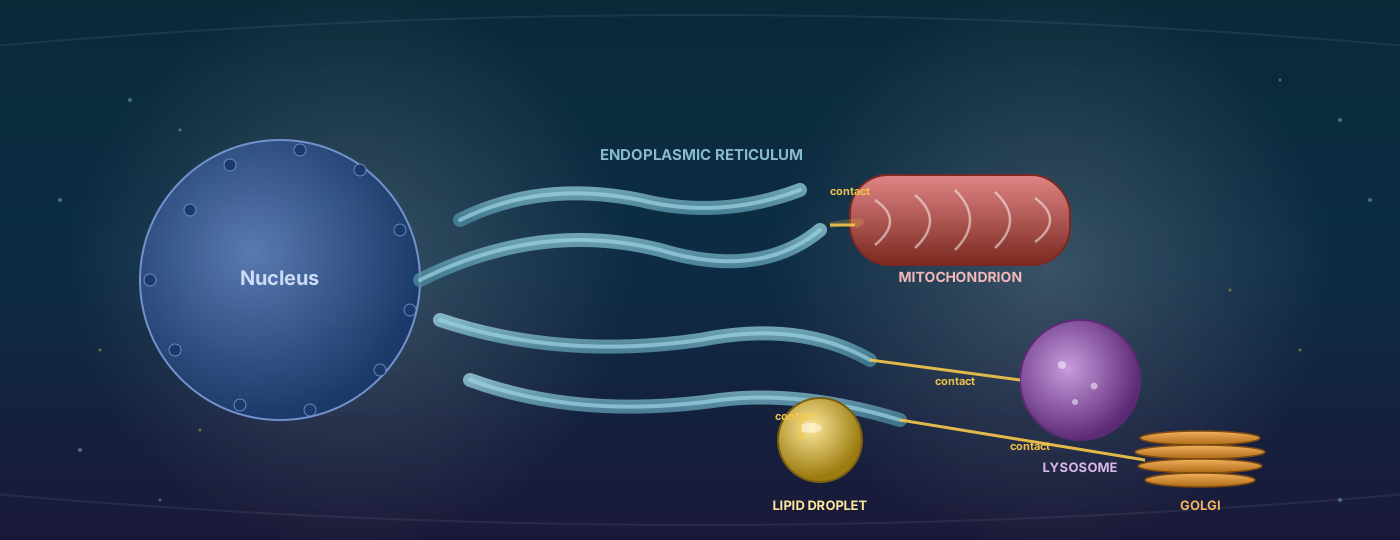
Organelles are not isolated compartments. They exchange lipids and signals at membrane contact sites, generating local platforms that shape organelle identity, trafficking, metabolism, and stress responses.
The Ji Lab asks which molecular tethers and lipid transfer proteins assemble these sites, what cargo they move, and why their dysfunction contributes to neurological, metabolic, and developmental disease.
Project 01
ER-Endosome/Lysosome Contacts
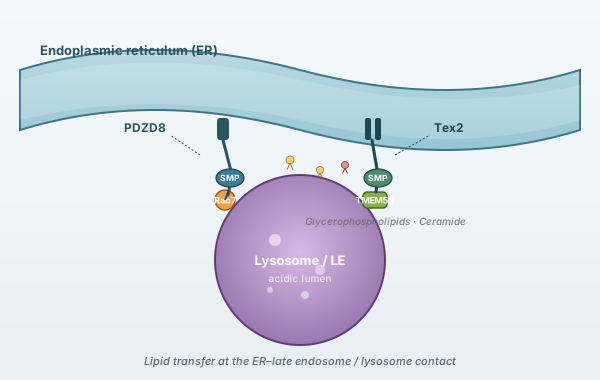
ER-endolysosome contacts regulate organelle positioning, membrane identity, cargo sorting, and lysosomal function. The lab showed that PDZD8-mediated lipid transfer at ER-late endosome/lysosome contacts supports organelle positioning and neurite outgrowth.
Subsequent work identified Tex2 as a tubular ER protein recruited by TMEM55 to ER-late endosome/lysosome contacts, where it supports lysosomal trafficking, digestive capacity, and membrane lipid composition.
Project 02
ER-Mitochondria and Lipid Droplet Contacts
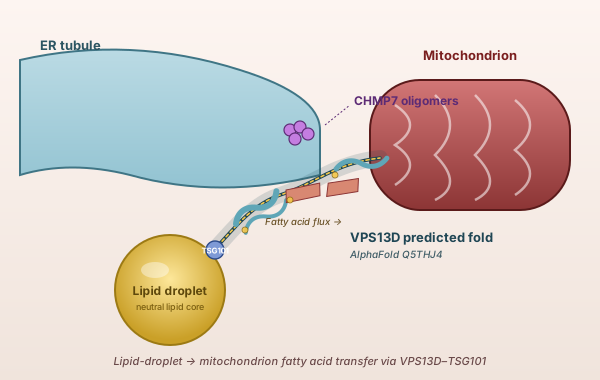
ER-mitochondria contacts coordinate mitochondrial morphology, metabolism, and organelle quality control. The lab discovered that VPS13D interacts with VCP/p97 to negatively regulate ER-mitochondria contacts and mitochondrial organization.
Under starvation, VPS13D and TSG101 facilitate fatty acid transfer from lipid droplets to mitochondria. The lab also showed that CHMP7 can mediate three-way ER junctions and ER-mitochondria interactions outside its canonical ESCRT role.
Wang et al., Nat Commun, 2021 · Du et al., Mol Biol Cell, 2021 · Chu et al., Cell Death Differ, 2023
Project 03
ER Exit Site-Golgi Interface and Cohen Syndrome
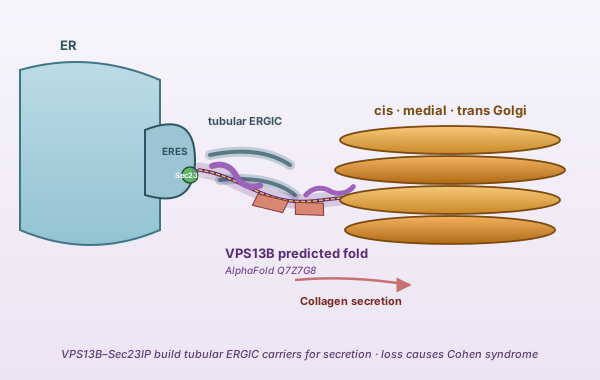
VPS13B/COH1 is the causative gene for Cohen syndrome, yet its molecular role had remained unclear. The lab identified Sec23IP as an adaptor that recruits VPS13B to ER exit site-Golgi interfaces and supports tubular ERGIC formation.
Disease-associated VPS13B missense variants disrupt Sec23IP binding, connecting a defined molecular interaction to defects in ER-to-Golgi transport and developmental disease biology.
Project 04
Lipid Droplet Biogenesis
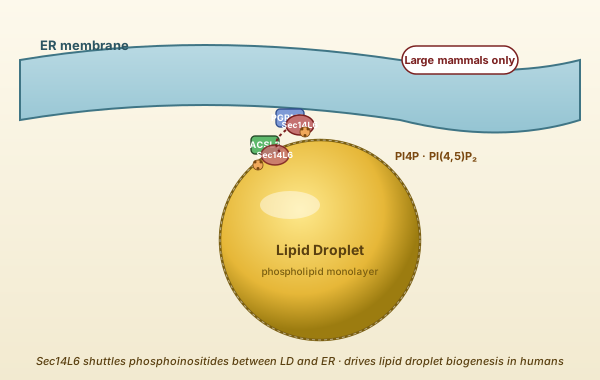
Lipid droplets form at the ER and require coordinated movement of phospholipids and signaling lipids. The lab identified Sec14L6 as a phosphoinositide transporter that regulates PI4P and PI(4,5)P2 homeostasis between lipid droplets and the ER.
Sec14L6 recruitment depends on ACSL3 at lipid droplets and PGRMC1 at the ER, providing a mechanistic view of lipid droplet biogenesis in mammalian cells.
Project 05
ER Sheets and Translocon Control
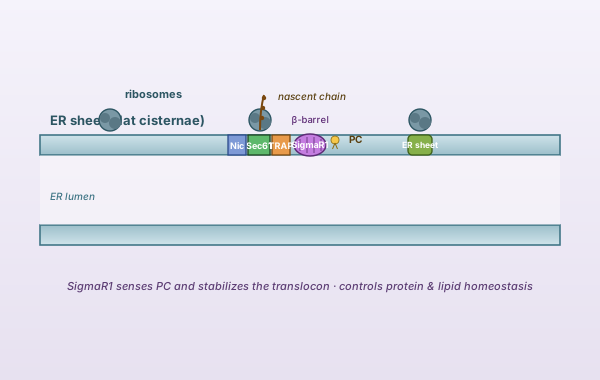
ER sheets host ribosomes and the protein translocation machinery. The lab showed that SigmaR1 is an integral ER membrane protein enriched at ER sheets and functions as an auxiliary translocon factor with phosphatidylcholine-binding activity.
Loss of SigmaR1 disrupts protein and lipid droplet homeostasis, connecting ER-sheet organization to broad cellular physiology.
Project 06
Bridge-Like Lipid Transfer Proteins
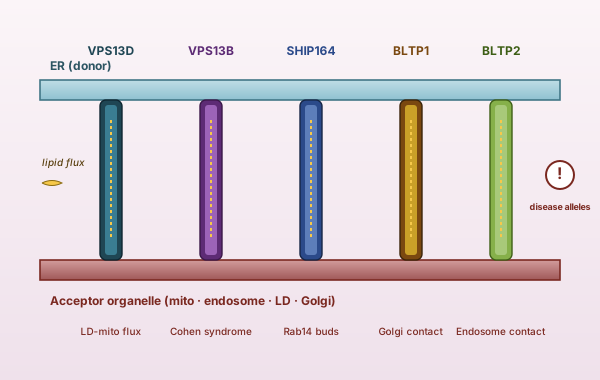
Bridge-like lipid transfer proteins can span organelle interfaces and move lipids in bulk. The lab identified a BLTP1-SHIP164-BLTP2 axis that promotes Rab14-positive endosome bud formation at Golgi-endosome contacts.
This work links lipid transfer at membrane contact sites to membrane expansion, endosome budding, and retrograde trafficking.